

The third leak in two years just got patched. Different wall, same house. At some point the question stops being “what’s wrong with this pipe” and becomes “what is this house piped with, and how much of it is left.”
The short version: three materials account for most of the repipe work in older Houston-area homes, each one fails in its own recognizable way, and you can usually identify yours in ten minutes with a flashlight. Once you know which one you have, the repair-or-repipe decision mostly makes itself.
First, find out what you have
You don’t need to open a wall. Water pipe is exposed in at least three places in almost every house: where the supply line comes in and hits the main shutoff, at the water heater connections, and under the sinks. Look at all three, because a house that has been partially repiped over the years can have two materials in it.
Galvanized steel is gray, threaded, and heavy. A magnet sticks to it. The EPA’s service line fact sheet defines it as pipe “made of iron or steel that has been dipped in zinc to prevent corrosion and rusting.” It was the standard residential water pipe for decades before copper took over, so a house from the 1960s or earlier is the usual place to find it.
Polybutylene is flexible plastic, most often a dull gray, though the inspectors’ association InterNACHI notes it “can also be white, silver, black or blue.” The tell is the stamp: it is “usually stamped with the code ‘PB2110’” along the pipe. It was, per the same source, “manufactured between 1978 and mid-1995” and “installed in up to 10 million homes in the United States during that period.” That window covers a good share of the houses that went up around FM 1488, Conroe, Spring and Tomball in the 1980s and early 1990s. If your house dates from those years, check for it specifically.
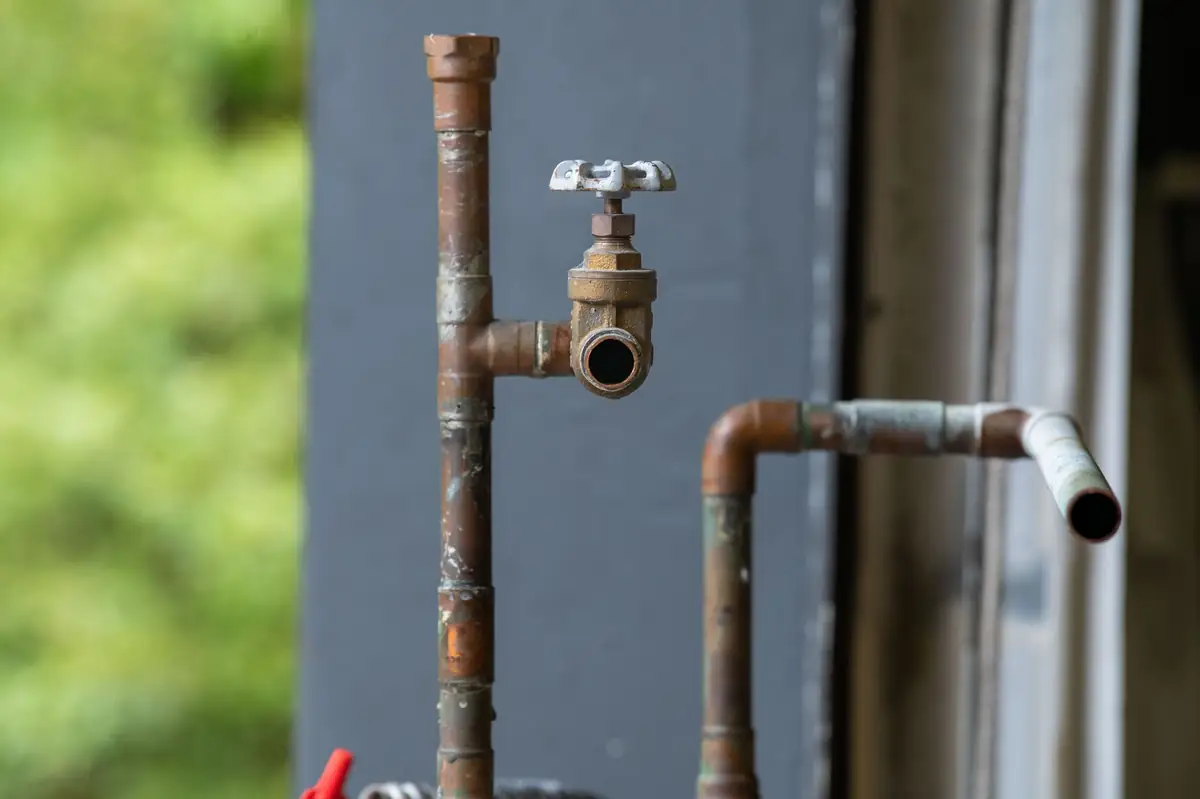
Copper is the one most people recognize: a reddish or brown metal pipe with soldered fittings. It’s a good material, and it’s also the one that pinholes.
Newer homes and any recent repipe will show PEX, a flexible plastic tube that is usually red, blue or white, with crimp or expansion fittings. If that’s what you see everywhere, this article isn’t about your house.
How each one fails
Galvanized rusts from the inside out. The zinc coating wears away, the steel underneath corrodes, and the rust builds up inside the pipe until the opening is a fraction of what it was. The symptoms arrive in order: rust-colored water on the first draw in the morning, then pressure that gets worse at the fixtures farthest from the meter, then a hot side that dies before the cold side because heat speeds the corrosion. By the time a galvanized pipe actually leaks, the inside of the whole system usually looks the same. The EPA’s 2024 lead rule goes a step further for the service line (the pipe from the street to the house): a galvanized one that “currently is or ever was downstream of a lead service line” is classed as galvanized requiring replacement.
Polybutylene reacts with the water. InterNACHI’s summary of the research is that “certain disinfectants can react with the polybutylene and cause it to flake apart at any location within the PB piping system.” Chlorine in the public supply, in other words, slowly attacks the pipe from the inside. It doesn’t corrode or narrow; it gets brittle and lets go, often at a fitting, often with no warning. The material was the subject of class-action settlements that InterNACHI puts at “payouts to homeowners reaching $1 billion,” and that history is why the same source warns owners might face “higher insurance premiums or be denied coverage entirely.” Ask your agent before you assume it is covered.
Copper pinholes. A pinhole is a tiny leak that opens where the inside of a copper pipe has been eaten through in one spot. Water chemistry, velocity at elbows, and stray electrical current all get blamed, and in any given house the honest answer is often “some of each.” The pattern to watch isn’t the first pinhole. It’s the second and third, because a system that is pinholing in more than one place is telling you about the whole run, not one bad fitting.
Repair, or repipe: the deciding questions
A single leak in a house with otherwise sound pipe is a repair. The following are the signs that a repair is buying time rather than fixing anything:
- The material is polybutylene. There’s no partial fix for a pipe that’s failing chemically everywhere at once. Once PB2110 turns up in a wall, the repipe is the plan; the only open question is the date.
- Galvanized with pressure loss. If the flow at the far bathroom has dropped and the water runs rusty, the pipe is closing up along its whole length. Cutting out one section and coupling in new pipe leaves the rest exactly as it was.
- A second pinhole in copper within a year or two of the first, especially on a different run.
- Leaks that keep landing in finished walls or ceilings. Each repair opens drywall, and the cost of the access starts to rival the cost of the pipe.
- You are already opening walls for a remodel, or you are about to sell. A repipe done while the house is open costs less in patching, and a house with new supply lines is an easier sale than one with a polybutylene disclosure.
If you do nothing, galvanized keeps narrowing and copper keeps thinning at whatever rate they were already going. Polybutylene is the one where doing nothing has a deadline you can’t see.
What a repipe involves
A whole-home repipe replaces every hot and cold supply line from the main shutoff to each fixture. It doesn’t touch the drains; those are a separate system and a separate question. The new material is PEX or copper. PEX snakes through existing framing with fewer fittings and fewer wall openings; copper is rigid and is the choice where it is exposed, where code or preference calls for it, or where a house is being restored to match. Both are listed on our services page, and either one is a system that will outlast the time most owners spend in the house.
Two things to plan for. Walls get opened at fixture locations and along some runs; a good crew tells you which ones before the first cut. And the water is off for the working part of each day, so ask about the sequence when you get the quote.
A repipe is also the moment to sort out the supply side as a whole. If your hardness number puts the house in the hard range, the softener guide from last week covers what a softener does for a new set of pipes and the water heater that has to live on them.
How we handle it
Whole-home repipe is licensed plumbing in Texas: under Occupations Code Section 1301.002, any piping used to “supply, distribute, circulate, or recirculate water” inside a building sits under the plumbing license, and so does its installation and repair. Our repipe work is PEX or copper, top to bottom, and it carries the one-year workmanship warranty listed on the site. Larger jobs like this are also what the financing option in our questions section is for.
The quote comes first, in writing, and it is the number you pay. If you have found gray pipe with PB2110 on it, or the far bathroom has slowed to a trickle, call (281) 786-3695. Tell us the year the house was built and what you saw at the water heater. Those two details usually tell us what we are walking into.