

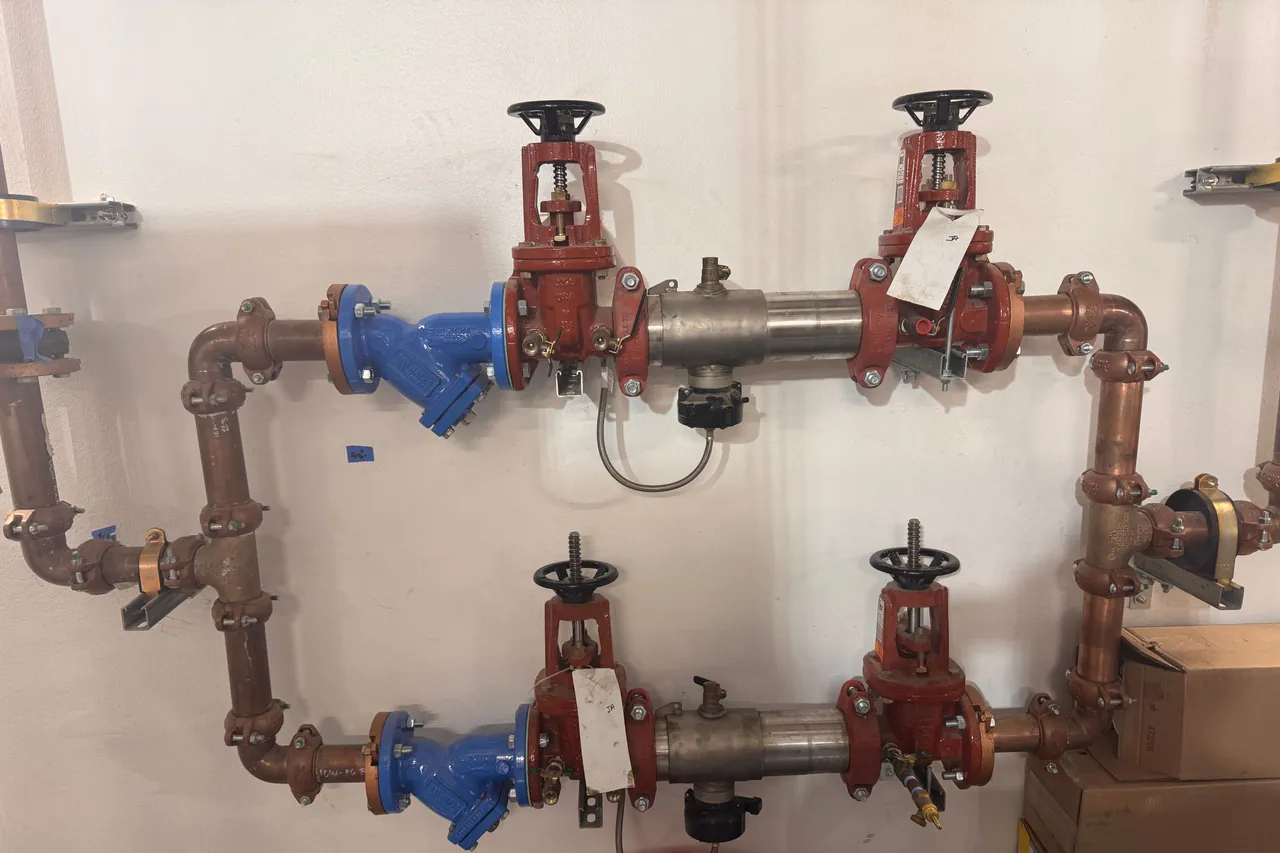
Most people never think about a backflow preventer until one of three things happens. They put in a sprinkler system. The water provider sends a letter saying the property needs one. Or the old one fails its annual test and can’t be rebuilt.
In all three cases the question is the same: which assembly goes in, where does it go, and what has to happen before the job counts as finished. Texas answers most of that in writing, so this is the plain version of what the rules say.
The short answer
The assembly is chosen by the hazard it protects against, not by price or preference. It has to be installed the way the manufacturer specifies, with enough room around it for a tester to get a gauge on it. And it has to be tested by a licensed backflow tester the day it goes in, with the report sent to your water provider. A new assembly that was never tested is, on paper, the same as no assembly.
Four kinds of assembly, and what each one is for
If you’ve never looked closely at one, they all look like a short run of brass with a couple of valves and some small fittings sticking out. They aren’t interchangeable.
Reduced pressure principle assembly (RPZ). Two check valves with a relief valve between them. If either check leaks, the relief valve opens and dumps water out of the assembly rather than letting it run backward. That’s why you sometimes see one spitting water onto the ground: it’s doing its job. This is the assembly used where the hazard is serious.
Pressure vacuum breaker (PVB). A single check with an air inlet that opens when pressure drops. You’ll often see one on a home sprinkler system. A spill-resistant version exists for spots where a little discharge would be a problem.
Double check valve assembly. Two checks in a row, no relief valve. It’s a lower-protection device, and the rules only allow it where there is no health hazard.
Air gap. Not an assembly at all, just open air between the end of a supply pipe and whatever it fills. Simple and effective, and impractical on most pressurized systems.
What Texas rules say about which one you can use
For irrigation, the state’s landscape irrigation rules (30 TAC §344.50) are direct. Where a health hazard exists, the allowed methods are an air gap, a reduced pressure principle assembly, a pressure vacuum breaker, or a spill-resistant pressure vacuum breaker. An irrigation system that has fertilizer or other chemicals injected into it is the textbook health hazard.
A double check valve assembly is allowed only where there is no health hazard, and only if it is tested upon installation. Your local authority can also prohibit it. That last condition is the one people miss. Whether a double check is accepted is your provider’s or city’s call, so a double check that passed somewhere else isn’t proof it’ll pass on your street.
On the drinking water side, the state rule for public water systems (30 TAC §290.44(h)) has the water provider match the protection to the type of hazard at the connection. So if your notice names a specific assembly type, that’s the provider applying the rule, and the assembly that goes in has to match it.
Where it goes, and why placement matters
The same irrigation rule sets the heights. A reduced pressure assembly has to sit at least 12 inches above the ground, somewhere it won’t end up underwater. A pressure vacuum breaker, spill-resistant or standard, has to sit at least 12 inches above any downstream piping and the highest downstream opening, because it relies on air getting in from above.
A double check can go below grade in a box, and the rule adds conditions when it does: the test cocks stay plugged with threaded plugs made of a non-ferrous metal except during testing, and there has to be clearance all the way around the assembly for testing and repair. Every assembly, above or below ground, has to be installed to the manufacturer’s recommendations with enough room to test it.
A few things we think through before picking a spot:
- Drainage. An RPZ that discharges needs somewhere for that water to go that won’t undermine a walkway or flood a flower bed.
- Freeze exposure. An above-grade assembly is exposed brass. Houston doesn’t freeze often, which is exactly why people don’t insulate them, and a cracked body shows up later as a failed test.
- Getting a gauge on it. If a tester can’t reach the test cocks without digging, every annual test costs more time than it should.
- The meter and the point of connection. Your provider may require protection at the meter rather than somewhere further along the line.
The test on day one
This is the part that turns a plumbing job into a compliance record. Both state rules say a new assembly is tested upon installation by a licensed backflow prevention assembly tester. The irrigation rule goes further: an assembly gets tested again any time it is repaired, replaced or relocated.
The tester connects a calibrated gauge to the test cocks and confirms each check and relief valve does what the specification says. The results go on the state’s test and maintenance report form, and the original goes to your water provider, which keeps it on file. If you would like to know what happens at the annual test after that, our guide to backflow testing in Texas covers who has to test, how often, and what happens when a notice is ignored.
Replacing an assembly that failed
Sometimes the new install is a replacement. The old assembly failed its annual test and the body is cracked, or it is old enough that parts are no longer made. In that case the same rules apply as for a first install: the right type for the hazard, the right height, room to test, and a test the day it goes in.
It is also a good moment to ask whether the old one was the right type in the first place. A double check that was installed years ago on an irrigation system that now has a chemical injector is a common example. If you have a well, a pool fill line or a rainwater system tied in near the house supply, mention it, because it changes the hazard and can change the assembly.
What to have ready when you call
- The notice from your water provider, if you have one. It often names the assembly type they expect.
- A photo of the old assembly and its tag, if this is a replacement. Make, model and size tell us what we are replacing.
- What the line serves. Irrigation, a pool, a commercial kitchen, a boiler, a fire line. The answer decides the assembly.
- Whether a chemical injector or fertilizer system is on the irrigation.
How we handle it
New backflow installs are part of what we do, alongside annual testing and repair, for irrigation systems, commercial buildings and homes. We match the assembly to what your provider requires, set it where it can be tested and drained, test it when it goes in, and file the report with your water utility so the record is complete from the first day. See the backflow section on our services list, or check our license and credentials.
Putting in irrigation, adding a pool, or holding a letter that says you need an assembly? Call (281) 786-3695 and tell us who your water provider is. That one detail settles most of the questions above before we arrive.